How the Durability Score Came to Be
2026-05-19
"Essentially, all models are wrong, but some are useful."
George E. P. Box
I've spent over 200 hours testing IronOS in my own training, using it with clients, and prompting AI to write code and iterate on every pixel in the app.
During this period of building and testing, I kept coming back to one thought: “Charting progress is fun when all the data is trending up, but what happens when age or other circumstances makes progress a thing of the past?"
Enter the Durability Score. The Durability Score aims to do two things:
Give a novice lifter a general strength target they could hit in 1-2 years of training scaled to their sex, weight, and age.
Redefine "progress" for the lifter approaching 50 so it's graded on how much strength has been retained, rather than how many PRs have been achieved.
While trying to solve for number one, I learned that strength standards simply don’t exist. I've got the full methodology for the Durability Score available in the app, but to keep things short: all strength standards are arbitrary.
The best I could do with IronOS was to work with AI to pick conservative numbers from the sport of powerlifting to serve as strength benchmarks to act as a guide for the most number people, through most ages.
Solving for number two was simpler, since we have a clearer idea of how much strength is generally lost year over year for a highly motivated lifter.
In short, this is what the durability score aims to accomplish.
to provide a strength standard for the novice lifter to strive to meet. A score of 100 means they're meeting the standard. Once the benchmark is met or exceeded, the lifter's own PRs become the standard by which they're measured going forward.
Redefine “progress” as the amount of strength a lifter retains year over year. Since the strength standard decreases year over year to account for age-related declines, a lifter can maintain a score of 100 as long as they hold on to their strength in line with expected yearly declines.
Like every other model, the Durability Score is “wrong”, but it’s also really useful.
My own training data tells the story of how the Durability Score can be used in practice. I started barbell training in late 2020 with the aim of building and retaining as much strength as possible heading into my second liver transplant. Not the best circumstances for maximizing one’s training gains, but life tends to work that way.
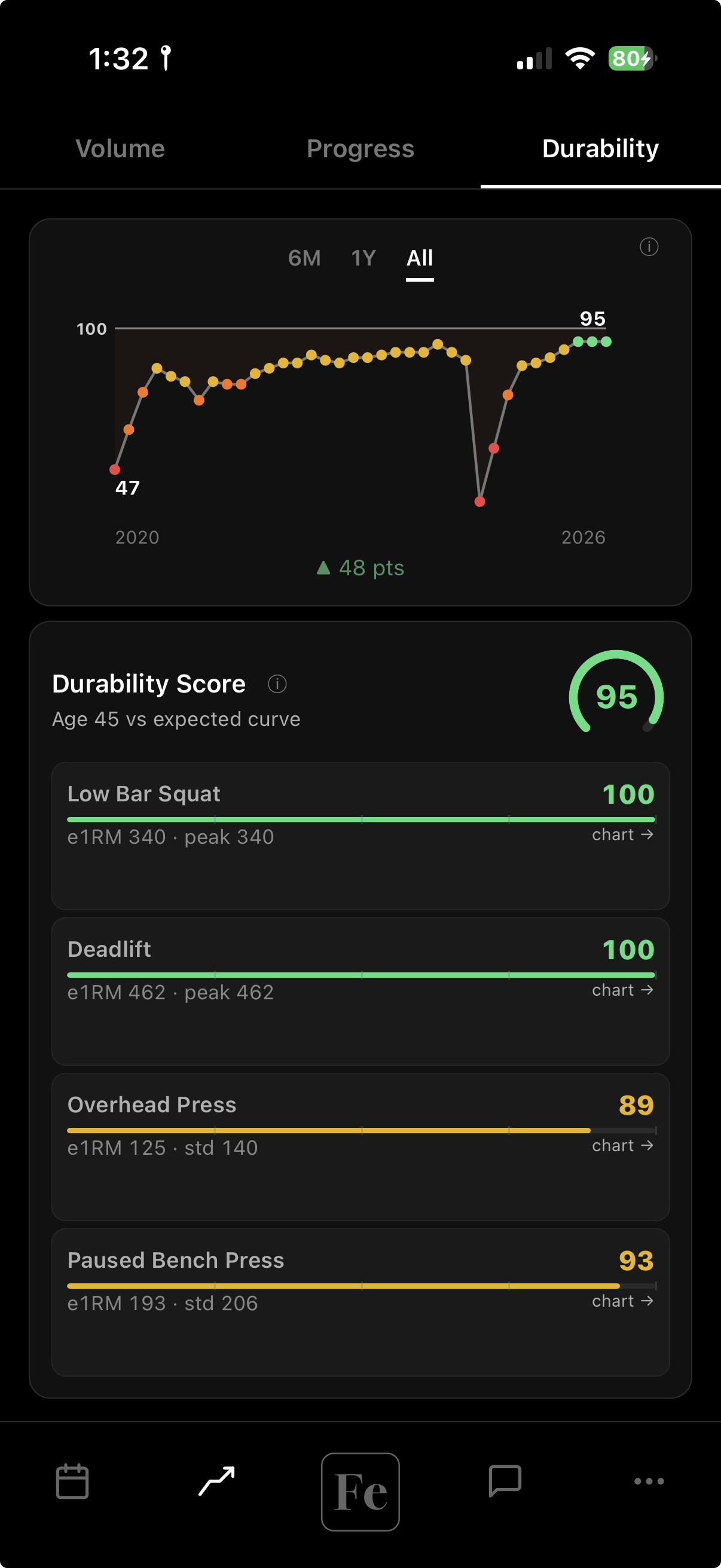
I didn’t have the durability score as a metric while leading up the my second transplant, but its simple logic was constantly running in my mind. It went something like this. “Life is going to get harder, and I need as much strength and muscle possible to reduce my suffering and improve the odds of having a great transplant outcome.
In the data, you can see a rapid increase in my durability score as I began training with a barbell in 2020. My durability score rose steadily until it drops precipitously in early 2025 while recovering after my second transplant.
To say my training was a success would be an understatement. In less than 1 year of training post transplant, I’ve already exceeded all my strength peaks pre-transplant.
Now nothing is impressive about my absolute strength numbers, but the story inside those numbers gives evidence of how the body can adapt to training under extremely challenging training circumstances (liver failure), recover from transplantation, and then set new benchmarks of strength.
If you have any questions about the Durability Score, suggestions for how to improve it, or have found it helpful in your training, I would love to hear what you’ve learned!